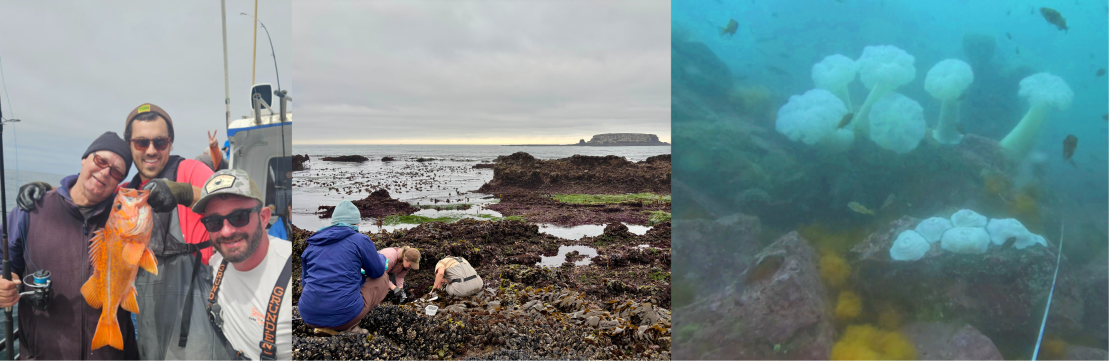
Photo: Snapshots of Fall 2026 ecological field work featuring a Yelloweye Rockfish caught in the Cascade Head Marine Reserve (left), volunteers hard at work in the intertidal at Otter Rock Marine Reserve (center), and a diver’s view from the Redfish Rocks Marine Reserve SCUBA survey (right).
October 21st marked the end of another busy and successful fall field season and the conclusion of our team’s 2026 ecological data collection. Below are highlights from the hook-and-line, SCUBA, intertidal, oceanographic, and juvenile fish surveys we conducted this fall. Thank you to the captains, collaborators, and volunteers who made this work possible!
Hook-and-Line: Hook-and-Line surveys were completed at Cascade Head and Cape Perpetua this fall. These surveys are an important tool to compare abundance, catch composition, and size of adult fishes inside the reserves with the same measurements from outside comparison areas that are still open to fishing.
We completed 6 days of surveys aboard the F/V Sunrise at the Cascade Head Marine Reserve and surrounding comparison areas with the help of 78 volunteers. We set a new catch record with 469 fish in one survey day! Other highlights included several new volunteers, an inquisitive octopus, and exciting recaptures of rockfish we tagged in the marine reserve earlier this year. We recaptured a Quillback Rockfish within 330 feet from where we originally tagged it 167 days prior. We also recaptured a Black Rockfish that we originally tagged 139 days prior in the same sampling cell.
We also completed 5 survey days at the Cape Perpetua Marine Reserve this fall aboard the F/V Misty and with the help of 53 volunteers. A big highlight was catching Brown Rockfish, a species we see almost exclusively in this area! On one survey day we caught 29. A Quillback Rockfish we tagged in the reserve in 2024 was recaptured over 2 years later in the same sampling cell!

SCUBA: We completed two survey days at Redfish Rocks Marine Reserve. Experienced divers from the Oregon Coast Aquarium carried out the dives, which went very smoothly. Data collection during SCUBA surveys helps us track changes in the abundance of invertebrates and algal communities and monitor habitats in the reserves and comparison areas. This information allows us to learn more about the relationship between marine communities, their habitats, and the impact of reserve protections.
SMURF: Juvenile fish surveys continued at Otter Rock and Redfish Rocks Marine Reserves and comparison areas in partnership with Oregon State University (OSU), the Oregon Coast Aquarium, and contractors from Port Orford. The Standard Monitoring Units for the Recruitment of Fishes (SMURFs) mimic kelp, attracting juvenile fish to hide in them. The SMURF moorings were deployed along with oceanographic sensors to track temperature and oxygen. Freedivers sampled the juvenile fish that settled in the SMURFs every two weeks throughout the season. This collaboration helps us understand how fish populations may be changing over time in response to reserve protections and broader environmental changes.

Oceanography: Across all five reserves and associated comparison areas, our oceanographic moorings collected important oceanographic data throughout the field season. The temperature and oxygen data we collect help determine if observed changes (e.g., abundances of adult fishes) can be attributed to the reserves’ protections or if those changes are due to ocean conditions.

Intertidal: In 2014, sea star wasting disease (SSWD) hit the Oregon Coast. To track the response and recovery of sea stars to SSWD, the ODFW Marine Reserves Program has collaborated with PISCO and the Menge-Lubchenco lab at OSU to survey sea stars and their snail prey in the intertidal areas of the Cascade Head and Otter Rock Marine Reserves since 2015. In 2026, these two sites yielded 887 sea stars counted by 13 volunteers. The three species were observed: ochre sea stars (Pisaster ochraceus), six-rayed stars (Lepasterias hexactis) and dwarf mottled stars (Henricia pumila). Only 1% of the sea stars showed signs of wasting disease, while 99% appeared healthy. A small percentage of the sea star population showing signs of wasting is a normal occurrence.