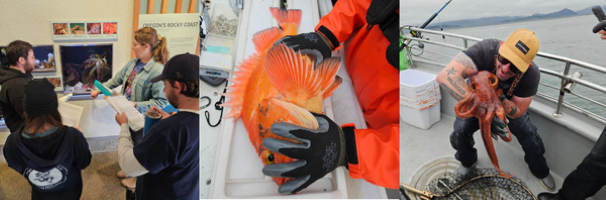
Photo: Snapshots of Spring 2026 ecological field work featuring species identification at the Oregon Coast Aquarium during SCUBA training (left), 26.8 inch yelloweye rockfish caught during Cape Perpetua Marine Reserve hook-and-line survey (center), and a giant Pacific octopus caught during Cascade Head hook-and-line survey (bottom left).
The Spring Field Season began on April 15th and will continue through June 15th. Dive in below to learn more about some of the hook-and-line, SCUBA, juvenile fish, and oceanography research that is underway. Thank you to our captains, volunteers, and collaborators who are helping us complete this work!
Hook-and-Line: Hook-and-Line surveys are underway in Cascade Head and Cape Perpetua Marine Reserves! Following an open call for applications, we have two contracts in place with local fishing vessels for Cascade Head and Cape Perpetua surveys. Leading up to the surveys, we trained 60 volunteers at our annual Biological Assistant Training to prepare them for a day on the water helping our team record data.
With the help of 35 volunteers, we completed three days of surveys aboard the F/V Sunrise at the Cascade Head Marine Reserve and surrounding comparison areas. Highlights included recapturing two Black Rockfish in the marine reserve that our team tagged in 2024, a record day of 467 fish caught in the reserve, and a Giant Pacific Octopus. We completed two survey days at Cape Perpetua Marine Reserve aboard the F/V Misty with the help of 24 volunteers. Highlights include catching many brown rockfish (a species we see almost exclusively in this area), recapturing a copper rockfish we tagged in 2024 on the same patch of reef, and a large 26.8-inch-long yelloweye rockfish!
Additional hook-and-line surveys will be completed in both reserves and comparison areas as weather permits. These surveys are an important tool for comparing fish size, abundance, and composition over time within the reserves and in comparison areas that are still open to fishing.
SCUBA: Working with partners at Oregon Coast Aquarium and Oregon State University, we completed a two-day SCUBA diver training. Together, we trained 12 divers on ODFW Marine Reserves SCUBA methods and got them in the water for some Oregon coast diving experience. With the Oregon Coast Aquarium, we completed one survey day at the Cape Falcon Marine Reserve. Despite some challenging weather shifts, we surveyed invertebrates, kelp, and habitat structure along eight permanent transects (fixed survey paths). Weather permitting, we will conduct an additional survey before the end of the field season. The data collected during SCUBA surveys helps us track changes in the size and abundance of invertebrates and algal communities and monitor habitat in the reserves and comparison areas. This information allows us to learn about the relationship between marine communities, their habitats, and the impact of additional protections.
SMURF: With the support of Oregon State University and the Oregon Coast Aquarium, we installed eight moorings across the Otter Rock Marine Reserve and Cape Foulweather Comparison Area. These moorings contain a SMURF device to collect juvenile fish and oceanographic sensors to measure temperature and oxygen levels. Additional moorings will be set up at Redfish Rocks Marine Reserve this month. The data collected through the SMURF project helps us understand how fish populations may be changing over time in response to reserve protections or broader environmental changes.
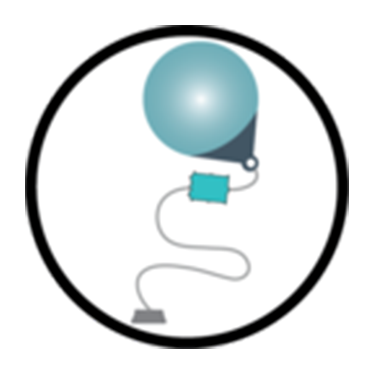
Oceanography: To complement the oceanographic sensors on the SMURF moorings, we deployed five additional moorings with temperature and oxygen sensors. With the support commercial fisherman Bob Browning and Aaron McKenzie, we placed two moorings in Cape Falcon and Redfish Rocks Marine Reserves and their associated comparisons areas. With the Oregon Coast Aquarium, we set up a mooring at the Cascade Head Marine Reserve. We will install another mooring at Cape Perpetua Marine Reserve and comparison area. Why oceanography? Oceanography data helps determine if ecological changes observed in other surveys (species size, abundance, composition, etc.) are due to the reserves’ protections or ocean conditions.